Getting to Grips with Dorothy Mead’s Hands by Fraser McFarlane by Theresa Kneppers

I wanted to select this work because of its frankness and simplicity. The similarity of the composition with other popular tropes and images which use hands provided a springboard into what the painting was suggestion. Personally, I really enjoy the wet brushstrokes Mead has used, but I didn’t want any part of the content to be about artistic taste in that way. All in all, I thought that the work had great untapped potential in contemporary culture, and wanted to contribute in some small way towards shifting it into the spotlight.


The process of making the video was a tough one for someone very new to video editing. The experience I gained making a YouTube video on the Borough group was invaluable. Thankfully, although a switch of software meant more work to relearn the tools I’d be using, it resulted in less work in the long-term as the new software I used was much more responsive and powerful. I discovered how important it is at all parts of the process to label and catalogue resources and recorded elements so that you can keep track of them easily whilst juggling what you want to do. Making a video like this can be very erratic, because despite the short length of the content, it takes a long time to piece together. I think I spent over 2 hours clicking through Tracy Beaker episodes in order to find that one clip I remembered and wanted to include of Camilla Lawson. By extension, sometimes I found that my idea of a meme or joke I wanted to bring in was fabricated, or I’d misremembered it. I would finally discover a clip I thought was appropriate and find that a few words were different in the phrasing which thus rendered the reference over-worked or irrelevant.

The project has of course helped me gain an awareness of where to improve. I found that I need to take better care not to load all of the content/transitions/jokes/flashy bits towards the front of the clip. Whilst I enjoy have a moment to extend dialogue and say something a bit more sophisticated, I think both of my video are a bit front-loaded and trail slightly towards the end. Ambitions I’d had to use a greenscreen were also met with practicalities of my current budget and ability, and certainly something I’d love to work with in the future.

 Lastly, it sounds like a platitude, (and I know I would eye-roll reading this) but I also think its crucial to enjoy yourself, because approaching the task as something to have fun with really helps to stay motivated.
Interpretation of the Meaning a new work by Sara Choudhrey by Theresa Kneppers

Interpretation of the Meaning, Sara Choudhrey

Watch the full piece here.

Still from Interpretation of the Meaning, Sara Choudhrey, 2020

Still from Interpretation of the Meaning, Sara Choudhrey, 2020

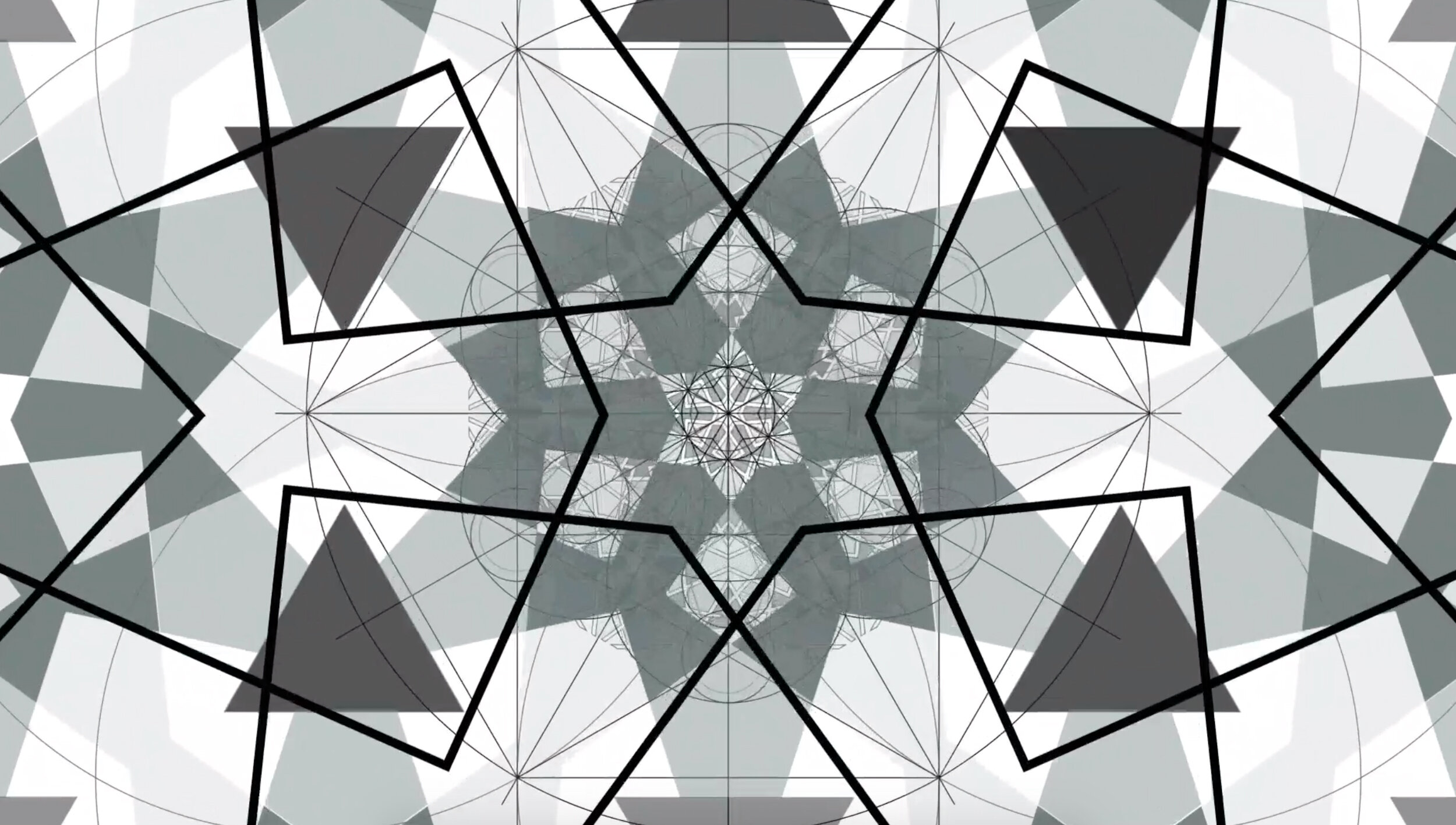
Layering, displacement, and motion are key elements explored in Interpretation of the Meaning, an animation produced in response to the early work of David Bomberg and his contemporaries engaged with the Vorticist and Furturist movements. It is a consideration of alternative ways of looking, of materiality, technological advancement and our perceptions of time and continuity.

David Bomberg is often portrayed as someone who was in lifelong search, in contemplation of a truth and seeking a sense of belonging. His work produced in response to time in the Middle East, and Toledo in Spain also resonated with me. There is also his diaspora identity whilst living in London, and his having travelled to locations significant to Islamic history, including Jerusalem. Of course, the contentious situation in this region has evolved greatly, and with a change and movement of time, one wonders what the futurists may have made of the world in which their works are viewed now.

The title of the piece:

There is also a strong theme of spiritual and religious heritage in the work, and is conveyed through the title ‘Interpretation of the Meaning’, a phrase that is used for explaining and translating sacred text, often from one language to another. It implies that in the process of translating, there is a limitation in portraying the original intended meaning. Those who are multi-lingual will appreciate this, where there may not always be an equivalent phrase or word to describe the extent and essence of the original, however, in using the phrase ‘interpretation of the meaning’ there is an implied acknowledgement and value for authenticity. The play on words continues in the notion of artistic movements, movement as portrayed in the audio, in the animation format, with its own timeline and the movement of the geometric forms.

The audio:

The audio for this artwork uses the sounds of various clocks ticking in and out of sync, with additional chimes and sounds of timepieces and machinery. They are as abstracted as the sense of the space that is being explored in this virtual and unknown landscape. The viewers movement and that of the geometric shapes is an investigation of what we perceive of as our surroundings and how a space is to us as we are to it. The sound is heavily influenced by my current surroundings at home, where my father, a horologist, has set up many clocks in the midst of repairs. They have not all been set up with the same times. The correction of the time shown on the clock face is almost arbitrary. These clocks embody their own timelines, speak of having their place somewhere, belonging to someone and therefore being of material significance. They act as both props and reminders of the passing of time.

The geometry:

The animation presents what is known as an Islamic geometric pattern. It is an expanded design from an in-laid panel from the early 16th Century Al Ghuri complex in Cairo, Egypt. I chose this pattern as I found the formation of shapes and structure intriguing. It is not common to find pentagons on a 6-fold composition yet upon analysis there appear to be hidden correlations in the structure of the design that allows the 5-sided shapes to become apparent through divisions in a 6-fold layout. The geometers from this period and region would have cleverly discovered these hidden properties but did not leave many clues behind regarding their construction methods, and so there is a further connection to the idea of interpretation here. It is only through deconstructing and analysing which allows for possibilities in reconstruction of the pattern, an aspect of my practice which I wrack my brain over but also thoroughly enjoy.

My interest in the Vorticist movement:

I am in awe of artists who were inspired and exposed to cubism and the style that developed into Futurism and Vorticism. There is an abstracted conveyance of the world through this style yet it is not entirely unidentifiable through the sliced forms. The style also lends itself to an acknowledgement of the geometry present in our habitat, whether spaces of nature or those which are constantly manipulated by humankind. I feel the success of the movement centred on a strong understanding and contemplation of the way we engage with spaces through movement and also our understanding of spaces centred on a perception of light.

Still from Interpretation of the Meaning, Sara Choudhrey, 2020

Still from Interpretation of the Meaning, Sara Choudhrey, 2020

Still from Interpretation of the Meaning, Sara Choudhrey, 2020

Still from Interpretation of the Meaning, Sara Choudhrey, 2020

Still from Interpretation of the Meaning, Sara Choudhrey, 2020

Still from Interpretation of the Meaning, Sara Choudhrey, 2020

Naming With Care Game by Theresa Kneppers

You are the curator of a digital collection. Trace the speculative provenance of the image and decide where it might go in the future.

Play Naming With Care Here

Stevie Rae Hope Scanner GIF by Theresa Kneppers

In examining the works of Bomberg, I found myself most interested in the textural quality of the work, which acts as evidence of the process of creating the painting, and of the painters presence within the work. Keeping this in mind, I chose to work with a scanner, creating my own self portraits and scanning as I painted, and also as I removed these paintings from the scanner bed in order to create the next one. I animated some of the painting process, to show how the buildup of paint works to create an image. The paintings created only exist permanently in digital form, as each is wiped away upon completion. 

See more works by Stevie Rae Hope here.

Why Did Dorothy Mead Experience Less Success Than Her Male British Modern Contemporaries? by Theresa Kneppers

Why Did Dorothy Mead Experience Less Success Than Her Male British Modern Contemporaries?

by Alice Mcleod-Bishop

Dorothy Mead was a loyal student to Bomberg and championed his work and methods even when the wider British art community was staunchly against Bomberg’s teaching methods and philosophy, leading to Mead being asked to leave the Slade before completing her studies there. It is difficult to know why the art-world failed to appreciate Bomberg’s works despite his students and friends being able to recognise his skills: perhaps they found his teaching style too unorthodox or were threatened by his approach and philosophy. Whatever the reasoning, the establishment was against Bomberg and the Borough Group as a result, which arguably hindered the flourishing of the group-members’ careers as galleries refused to exhibit their work. 


According to Borough Group founding member Cliff Holden, some of those who were in close contact with Bomberg made a mockery of his practice, by recreating (arguably, cheapening) Bomberg’s stylistic affects. One of these individuals is world renowned artist Frank Auerbach, who was an avid student of Bomberg’s from 1947-1953 and the most successful of Bomberg’s students. Auerbach did not join the Borough Group or Bottega during their existence as it seems he intended to not be as closely associated with Bomberg and his followers. It is quite clear when examining Auerbach’s work how heavily he was influenced by Bomberg, especially when you compare Auerbach’s paintings with Mead’s, who was proud to be Bomberg’s student. 

(left: Mead, Reclining Figure, 1954; right: Auerbach, E.O.W Nude, 1954)

(left: Mead, Reclining Figure, 1954; right: Auerbach, E.O.W Nude, 1954)

(left: Mead, Self Portrait, 1960; right: Auerbach, Julia, 1992)

(left: Mead, Self Portrait, 1960; right: Auerbach, Julia, 1992)

(left: Mead, Industrial Landscape, Evening, 1947; right, Auerbach, Building Site Earl’s Court Road: Winter (Replica), 1955)

(left: Mead, Industrial Landscape, Evening, 1947; right, Auerbach, Building Site Earl’s Court Road: Winter (Replica), 1955)

Auerbach’s style does differ from Mead’s – for example he depicts less form and uses thicker or more paint – but the Bombergian influences in both their work is clear on examining some of Bomberg’s paintings in the Borough Road Gallery’s collection. So why did Mead find little success where Auerbach found fame and fortune? It is certain that Auerbach’s distancing from Bomberg and the groups associated to him allowed for his career to flourish since critics, galleries, buyers, and others were unbiased regarding his art since they generally held a strong dislike toward Bomberg. Those who were part of the Borough Group and the Bottega failed to break through because Bomberg’s methods and philosophy were misunderstood, explaining how Auerbach, who had similar stylistic techniques and subjects in his paintings compared to Mead, was so successful despite being taught by Bomberg. 

It can also be inferred that Mead’s gender had a great deal to do with her career not finding the success it had the potential to. Female artists have had the odds stacked against them for as long as society itself has been patriarchal. Until recently, non-male artists were rarely commissioned to make work, and ratio of male to female artists in galleries always shows there are more male artists being exhibited, sold and critiqued. The men who were influenced by Bomberg and were closely aligned to him, such as Holden, still found more success than their female counterparts. And the men who were influenced by Bomberg and distanced themselves from his philosophy, such as Auerbach, found even greater success. Considering that Auerbach was three years younger than Mead, they were certainly contemporaries and so the comparison between their works is relevant, highlighting the distinct differences between their careers. If Mead had distanced herself from Bomberg and continued to study at the Slade, as Auerbach did, she might have been a considerably more well-known and successful artist; and yet, maybe her allegiance to Bomberg and her respect for his teachings made her the artist she became. 

Is Life Drawing the Same During COVID-19? by Theresa Kneppers

Is Life Drawing the Same During COVID-19? by Alice Mcleod-Bishop

“The exercise of drawing from life brings out the individuality of the artist in the man”[i]

Left, via Zoom; right, from life

Left, via Zoom; right, from life

This collection of life drawings aims to examine how artists can use technology to overcome the constraints of the Coronavirus pandemic of 2020, and how this has affected the practice of life drawing and the drawings themselves. Life drawing was an integral aspect of Bomberg’s teaching and he valued how one can learn to depict a subject through drawing them from life, moving the artist and the subject to gain a full perception through different physical perspectives of the sitter; it is considered by most artists to be a valuable practice in learning how to visually depict a subject. 

Alice Mcleod Bishop life drawing sketches.png

Sketches done from life

Given the social distancing aspect of managing the pandemic, and the encouragement to stay inside with little to no contact with other households, life drawing in the traditional sense is somewhat an impossibility. However, video-calling technology (Facetime, Skype, social media ‘lives’ and most commonly Zoom) has enabled people to have some normalcy in some aspects of life, and people have hosted virtual life-drawing classes to continue their practice.

Alice Mcleod Bishop Life Drawing.png

Left, via Zoom; right, from life

This collection of life drawings demonstrates the difference between drawing sitters in person compared to drawing the same people via Zoom. I found that in drawing via zoom, I struggled to really grasp an accurate perspective of my sitters, and I found it hard to make my subjects look like themselves in their bodies, in comparison to drawing the same sitters in person. When drawing them in person, I saw more shading and shapes, thus making the drawing itself and the drawings more interesting.

Alice McLeod Bishop Life Drawing.png

Process documentation of life drawing via Zoom (left to right: 3 minutes, 10 minutes, 20 minutes)

An example of a sitter over zoom

An example of a sitter over zoom

I also found it difficult to capture my sitters’ essence and understand how to represent the ‘Spirit in the Mass’ in the subject, particularly when I compare that experience to drawing my sitters in person. While I am close with both subjects, it was hard to portray some evidence of their selves in my works over Zoom, and the drawings seem decidedly flatter and colder when observed in comparison to drawings done in person. This is likely because one’s physical view of the sitter is 2-dimensional, and thus it is hard to gain a full perspective of the sitter from various angles, something which Bomberg defended when it came to his life drawing classes.

Process documentation, drawn from life

Process documentation, drawn from life

Overall, the experience of life drawing and being able to gauge a person’s essence was unmatched via Zoom. Drawing over a videocall felt far more like drawing an object as a still life rather than drawing a person. Using Zoom felt incredibly impersonal and stilted, whereas life drawing in person makes it easy to capture the Spirit in the Individual. Despite this, I was able to maintain my style and stylistic approach to life drawing and enjoyed the experience. If one can practice life drawing in any capacity it still has value, especially during a pandemic; it allows you to connect in a time where people have become so unnaturally disconnected.

Drawn from life.

Drawn from life.

Thank you to my lovely sitters.

[i] (Bomberg, quoted in Buchowska ‘teaching art in post-war Britain: the case of the Borough Group’, p. 115)

Virtual Backgrounds by Theresa Kneppers

Back in April we reimagined digital images in the archived collection as video call backgrounds that fit standard conferencing platforms. The images are inserted in the generic interiors and are stretched beyond the size of the original dimensions of the work. The virtual backgrounds become potential backdrops for users to demonstrate their knowledge of the collection or mask their domestic spaces.

Mann_Cityscape.jpg
holden_standing_figure.jpg
Two_Figures_Mead.jpg

The Spirit in the Mass in Dorothy Mead’s Paintings by Theresa Kneppers

by Alice Mcleod-Bishop

Dorothy Mead (1928-1975) joined the Borough Group in 1946 as an original member of the group which was dedicated to portraying David Bomberg’s (1890-1957) Modernist teaching methods and his philosophy known as the Spirit in the Mass, until the group’s dissolution in 1951. The notion of Spirit in the Mass was primarily about the connection between art and wider life, where he aimed to capture someone as they are in the world rather than as a subject. He understood the ‘self’ as a conditional relationship in consideration of its surroundings, taking into account the artist’s perception of the subject, as well as the phenomenology (the experience of experiencing something) of the subject – to capture what it is like for the sitter, landscape, cityscape etc., to be and exist as itself rather than solely the artist’s depiction of what it might look like at face-value. The idea of mass specifically relates to the synthesis of thought and feeling: the artist must assume ignorance about the subject whilst not being ignorant, and show the world as we see it, as uncertainty. Bomberg believed that modernist drawing is seen “as a deliberate distortion of optical truth”[i], and thus one must be classically trained if aiming to distort; yet if the artist is concerned with how things ‘feel’, then what they draw will naturally be a subjective and therefore distorted view of reality. 

This is what drove Bomberg to teach his anti-establishment methods, which in turn meant he was met with distaste and disapproval from the contemporary art community and was not recognised as a legitimate teacher. His views were widely misunderstood due to the lack of clarity surrounding his ideas and the somewhat confusing way in which they are worded in the Bomberg Papers. Contemporary critics and teachers failed to ascertain what Bomberg’s philosophy entailed, and to this day his teachings are confused by many[ii]. It is highly difficult to truly grasp exactly what Bomberg aimed to portray in his classes and what is the Spirit in the Mass; it seems that only those who were his students managed to understand Bomberg’s revolutionary methods and accurately capture what Bomberg perceived to be the Spirit in the Mass. 

Mead portraits.jpg


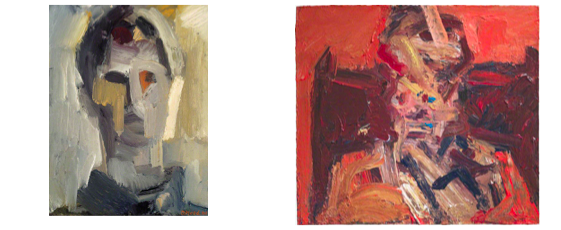
One of these students was Dorothy Mead, who was especially dedicated to Bomberg’s methods and was forced to leave the Slade art school because of her allegiance to the British Modernist artist. Bomberg’s influence on Mead is evident in her paintings, particularly her depictions of bodies, figures and landscapes: stylistically, Mead’s work is reminiscent of Bomberg’s post-war paintings, using thick expressive brush strokes and dark colours to portray a sense of the subject and its essence, an idea that was integral to Bomberg’s philosophy. It is difficult to delineate precisely how far Mead was able to capture the Spirit of her subjects, since we cannot know in detail her relationship with what and who she painted, nor how far she allowed her subjectivity to distort her reality. One can assume with some confidence however that she aimed to exact the Spirit of her subjects through her use of colour and the presentation of form in her works. In her 1955 work Portrait[iii]  (left)she uses bold yellow and blue brush strokes over a dark red and brown background to create the suggestion of an anonymous sitter. Compared to her undated self-portrait titled Self-Portrait[iv](right), it is clear she perceived herself quite differently to her sitter in Portrait. The use of duller colours and more succinct brush strokes in Self-Portrait might suggest she had a less-than passionate view of herself, while the vibrant, even violent feel to Portrait implies a potentially tumultuous or impassioned view of her unnamed sitter. This short comparison highlights how Mead attempted to portray her perception of her subjects and thus how she interpreted Bomberg’s philosophy of the Spirit in the Mass; the different stylistic techniques in her depiction of herself compared to that of her subject is evidence of an attempt to capture the essence and phenomenology of the individual.


[i][i] Roy Oxlade, Bomberg Papers: The Spirit in the Mass, a commentary, together with transcriptions of various previously unpublished notes, p. XIV (introduction), Royal College of Art, 1980

[ii] Cliff Holden, Bomberg’s Teaching – Some Misconceptions, p.3, 2004, Cliff Holden

[iii] Dorothy Mead, Portrait, 1955, Borough Road Gallery Archive

[iv] Dorothy Mead, Self-Portrait, (undated), Borough Road Gallery Archive