Ask who was in the Borough Group and you will get a confident answer, and a different one depending on who you ask. Our own About page says the Group's formation "has been variously described". Leslie Marr put it more bluntly in 2005: by then the claims, counter-claims and denials had gone on for fifty-five years (as reported by Kate Aspinall).
This post puts the main published lists side by side. It doesn't try to settle the question. It tries to show where the disagreements are, and what they tell us about how a history gets written.
The lists
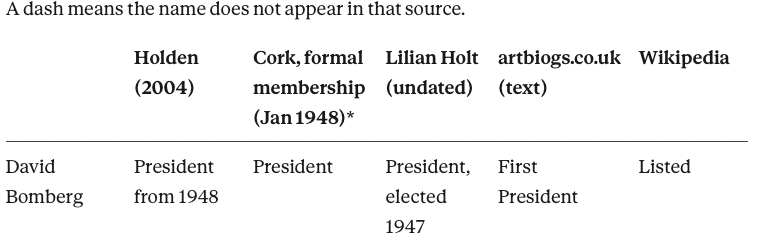
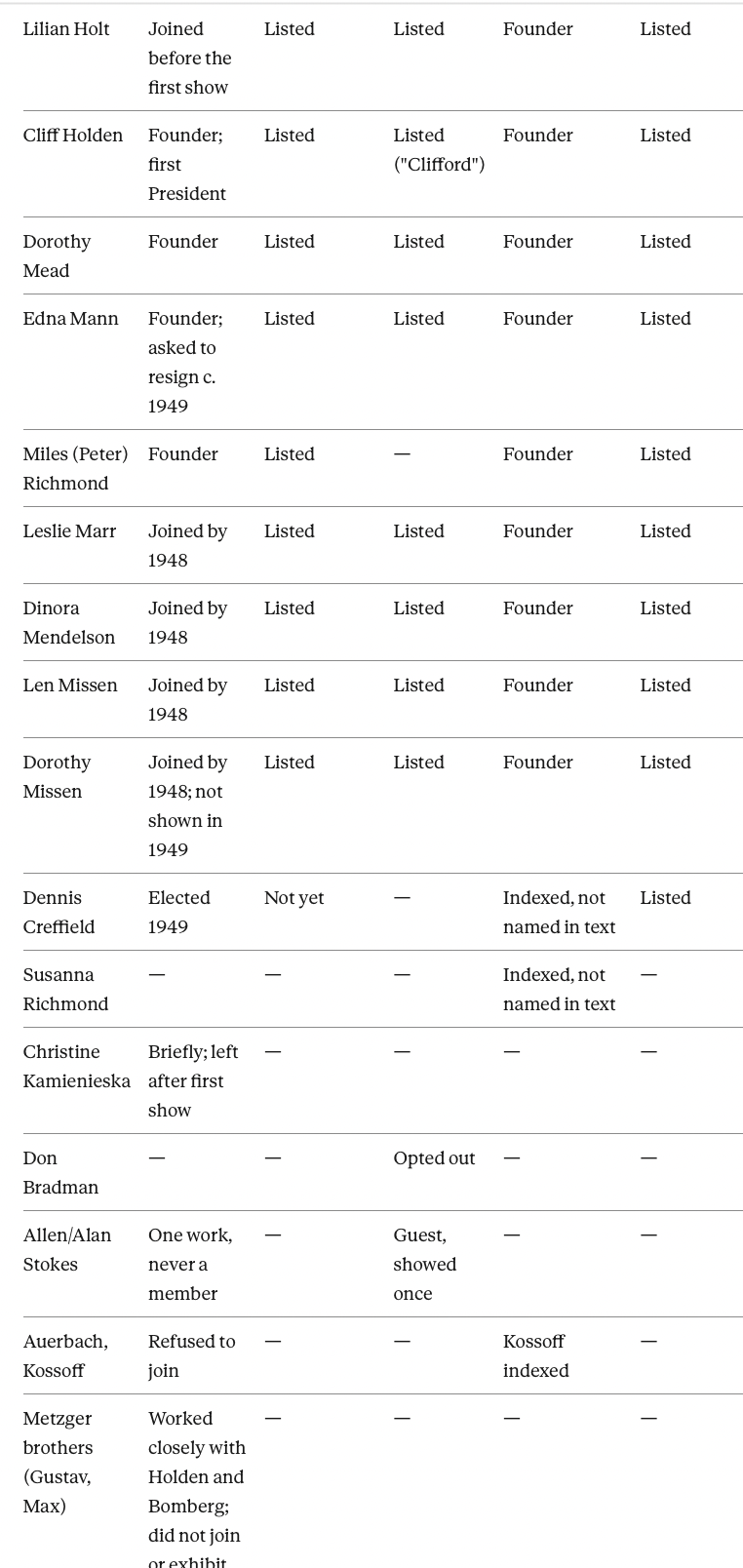
*As transcribed in our 2017 archive post from Richard Cork's David Bomberg (1987), pp. 274–5.
Aspinall's list. Footnote 8 of her 2016 paper, "Mark of the Times", under the heading "Members included" and citing Cork p. 261, names: Holden, Mann, Mead, Gustav and Max Metzger, Creffield, Dorothy Missen, David Scott, Ian Gordon, Don Bradman and Cecil Bailey. Note that it includes the Metzgers, whom Holden says never joined, and Bradman, whom Holt says opted out. This looks like a broader group than the formal list, and it may mix class participants with Group members: in her 2020 Tate Papers article she separates the Borough class from the Group. We have not seen the footnote's source page, so treat it as Aspinall's list and not as Cork's. She adds that, according to Holden, Auerbach and Kossoff were never members.
Marr's list. Leslie Marr, in his own 2005 account (our 2017 archive post), says ten elected members were designated Founder Members at the 1948 constitutional meeting: Bomberg (President), Lilian Bomberg, Mead, Mann, Holden, Richmond, Dinora Mendelson, Marr himself, Len Missen and Dorothy Missen. That is the same ten as Cork's formal list. Creffield, he says, was the only other member elected before the Group dissolved.
Where they disagree
Who founded it. Holden names four foundation members in 1946: himself, Peter Richmond, Dorothy Mead and Edna Mann. Lilian Holt remembers it differently. An exhibition at the Everyman Cinema was offered first to Bomberg, who declined, then to Leslie Marr, who felt he wasn't ready, and finally to Mann, Mead and herself, and the title came out of a conversation with Bomberg on the walk home from the Borough. Richmond is in Holden's list and in artbiogs but not in Holt's. Aspinall, drawing on Holt's document and others, has Dinora Mendelson recruiting Richmond, Marr and Len Missen to the class. Simon Schama, in a 2024 essay on Bomberg and Rembrandt, describes Marr and Creffield among the students who "went on to form" the Group. That is a broader account of its formation than Holden's, which names four original members in 1946 and has Marr and Creffield joining later.
Marr and Mendelson. Marr agrees that the Group began in 1946 with four students and that Lilian Bomberg and Christine Kamienieska joined a year later. But he disputes the narrow idea of who counts as a founder: at the 1948 meeting, he says, ten elected members were designated Founder Members, and he cites a Bookwork Gallery press release in Bomberg's hand calling Bomberg "the founder of the group". He reports that Holden and Mead objected at that meeting to Bomberg bringing in his family and people they thought amateurs. Dinora Mendelson, in a 2005 account, states that there could be only one President, Bomberg, and that Holden's claim to the presidency is untrue. These are not just differences of memory. They are competing views of when the Group began, who had the authority to establish it, and what membership meant, and they were bound up with personal relationships.
Who was President, and when. Holden says he was the first President and resigned after criticism from inside and outside the Group, handing over to Bomberg. Cork agrees that Holden resigned and that Bomberg took the presidency at a January 1948 meeting, when a written constitution and a formal list of members were drawn up. Marr places the constitutional meeting in February 1948, and says the Group had no elected officers before it, so that Holden's own statement that Bomberg proposed him shows there was no formal election. Holt says Bomberg was elected in 1947 and that a report in Art News and Review was wrong to say otherwise. Mendelson says Bomberg was the only President.
Who was in, and who was merely near. Aspinall separates four things that the lists blur together: the Borough class itself, a loose network that came and went; the Borough Group, a consciously formed exhibiting collective (1946–50, in her dating); the Borough Bottega (1953 to about 1955), which Bomberg founded as a deliberately hierarchical workshop; and a wider tendency towards thick paint and pugnacity that spread through second- and third-degree contact with Bomberg and his students. Auerbach and Kossoff belong to the class and the tendency. Holden's account says both refused to join the Group, and says the Metzger brothers worked closely with him and Bomberg without joining or exhibiting. Many of the disagreements are really people answering different questions.
The index versus the text. The artbiogs page indexes nineteen artists. Its narrative names nine founder members, including Dorothy Missen, who has no biography entry of her own. The index includes Bottega-era names (Bailey, Gribble, Hatwell, Michelmore, Oxlade, Holmes, Scott), Kossoff, and Susanna Richmond, who is not named in the text. A list with biographies is also a decision about who gets one.
Names inside the lists. The same people travel under several names: Peter and Miles Richmond; Lilian Holt and Lilian Bomberg; Dinora Mendelson, "Mendleson" and Davies-Rees; Allen and Alan Stokes. Holt and Aspinall identify Edna Mann's husband as Don Bradman. However, papers shared with us by the Baldwin family identify him as Don Baldwin. We have not yet established whether these refer to the same person, or whether one of the accounts contains an error.
Dates. Holden dates the Group 1946–51 and says it was disbanded in spring 1951, as does artbiogs. Marr says it dissolved in early 1950, and Aspinall's 2020 Tate Papers article gives 1946–50, though her 2016 paper says 1946–1951. We do not treat any of these as the settled end date. The artbiogs entry says the first show was in 1947 and that "a group of the same name was formed" the following year. Holden's own biographical profile reportedly records seven Borough Group exhibitions between 1946 and 1951, a figure repeated on Wikipedia. We have not yet matched that count to named exhibitions.
A membership that changed
The lists also disagree because membership was never fixed.
1946: Holden, Richmond, Mead and Mann (Holden's account).
Before June 1947: Lilian Bomberg joins, and a Polish countess, Christine Kamienieska, who leaves after the first show.
December 1947: An Everyman Cinema show, which Cork says was not an official Group event. The addition of Marr and Mendelson caused dissension.
January or February 1948: A constitution and a formal list are drawn up and Bomberg becomes President (Cork says January, Marr February).
1949: Creffield is elected. Dorothy Missen is left out of the Arcade Gallery show. According to Holden, Bomberg asks Mann to resign because she is pregnant, believing motherhood would prevent her from becoming a professional painter.
Early 1950 (Marr) or spring 1951 (Holden, artbiogs): The Group is disbanded.
Whether Edna Mann "was a member" depends on the year you ask about.
What we're changing
Two things. First, in "Women of the Borough Group" we described Susanna Richmond as a full member. On this evidence that was too strong. She appears in the artbiogs index, but none of the membership lists above names her, so we will revise that post to say so. Second, in our own cataloguing, "member of the Borough Group" should not stand alone as a statement of fact. We will record who listed the person, and in what year.
A call to archives
We would especially like to find:
the 1947 Archer Gallery and 1949 Arcade Gallery catalogues, which name exhibitors
the written constitution Cork says was drawn up in January 1948
any surviving minutes (Holden says the earlier ones were lost)
the Art News and Review notices from 1947–49
anything that settles Edna Mann's husband's surname
If you hold any of these, or know someone who does, please get in touch.
Sources consulted: Cliff Holden, "The History of the Borough Group" (2004, cliffholden.co.uk); Richard Cork, David Bomberg (1987), as transcribed in our 2017 archive post; Lilian Holt, untitled account, Marr Papers, Tate Archive, as published in our 2017 archive post; Leslie Marr and Dinora Mendelson, accounts of the formation of the Borough Group (BRCA, 2017); Kate Aspinall, "Artist Versus Teacher," Tate Papers no. 33 (2020); Kate Aspinall, "Mark of the Times: Charcoal and the Borough Group" (2016); artbiogs.co.uk, "Borough Group"; Wikipedia, "Borough Group"; Simon Schama, "Laying it on Thick," in Rembrandt Seen Through Jewish Eyes (Amsterdam University Press, 2024).